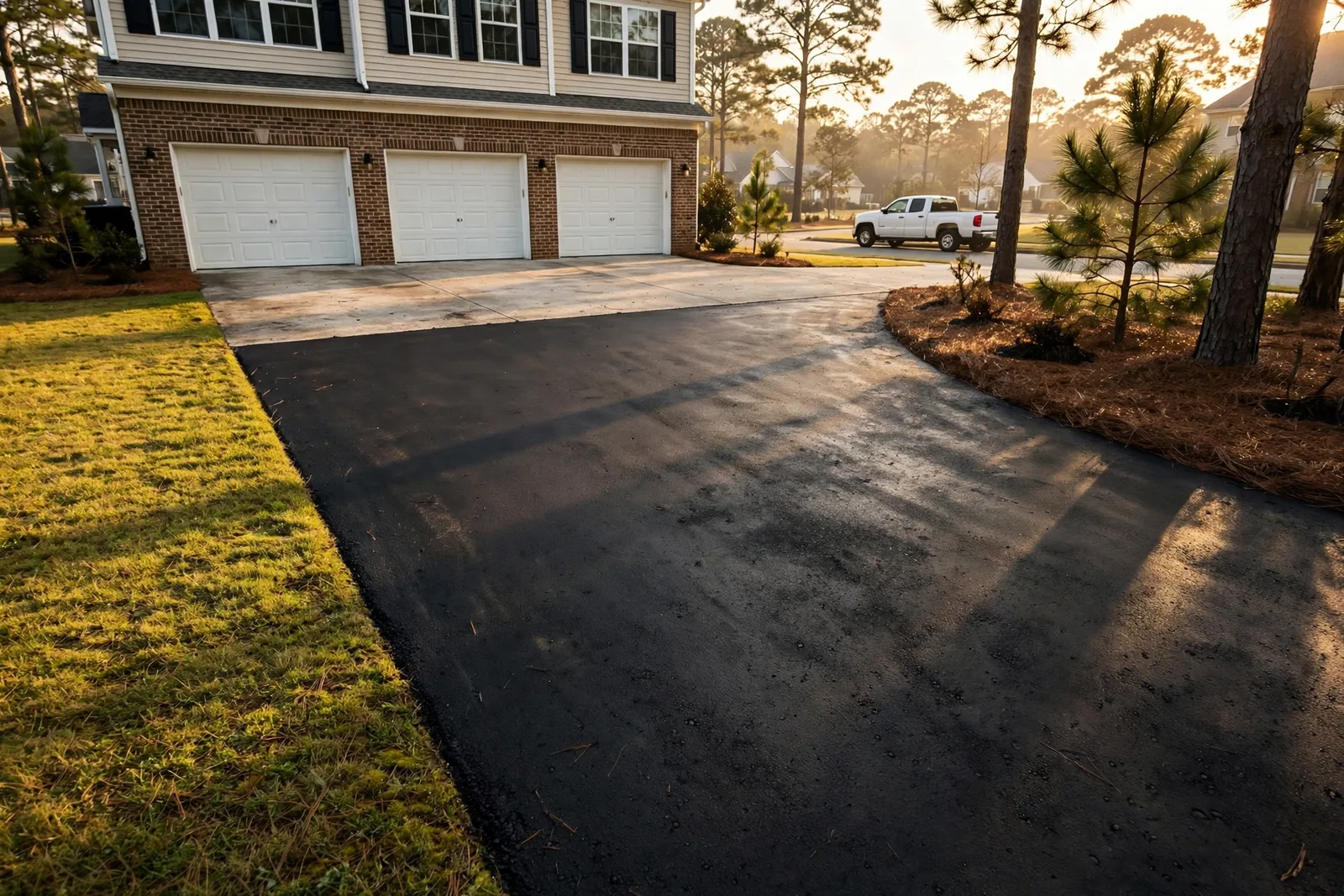
Leland Pavement Care keeps asphalt in working shape for homes, businesses, HOAs and churches across Leland and the rest of Brunswick County. The work is asphalt sealcoating, driveway sealcoating, parking lot sealcoating, crack sealing, pothole repair, line striping, parking lot maintenance and driveway repair. Derek Sandlin is our operations manager, and he runs that work day to day. He walks your drive or lot before it is quoted, measures it, tells you what it needs and puts the price in writing, and if rain moves your day he is the one who calls you. We maintain and repair pavement. We do not lay new lots or roads.
That means the driveway in a Brunswick Forest cul-de-sac, the amenity lot behind a clubhouse, the church lot that fills on Sunday morning and the retail lot along Village Road. Most jobs start with the coating itself, a layer of sealer that protects a surface from sun, oil and water, laid thin on a home drive and across a whole business or church lot at the larger end. A coating only works on a sound surface, so the cracks get filled first, and a failed spot gets cut out and rebuilt rather than topped off with a shovel of cold mix. Fresh pavement also needs its markings, painted back so the stalls, aisles and crosswalks read clean again. Owners who want all of it handled on a schedule can put a lot on a standing program, and homeowners whose drives are past coating alone can ask us about fixing the drive itself.
A good sealcoat job shows in the edges. Clean lines at the grass and the garage apron mean the crew cut in by hand before the open area was coated, and that the surface was cleaned first.
What we do
Every service below is priced by the measurement that actually drives it: square feet of surface, linear feet of crack, or the individual repair. The bands here are our prices. The section after this one lays them out with what moves a job up or down inside each band.
This is the base service. We apply asphalt-emulsion sealer by spray, squeegee or both, and offer polymer-modified sealer as the premium grade on commercial lots. Residential work runs $0.15 to $0.25 per square foot and commercial work runs $0.20 to $0.40 per square foot. Commercial lots get two coats.
Most home driveways here come in between $600 and $2,000. Size sets the price first. Then come the cracks that need filling and the oil spots that need priming. Small drives carry a minimum fee.
Lots use the commercial rate of $0.20 to $0.40 per square foot, and large lots price toward the lower end. Crack sealing, cleaning and oil-spot priming are priced on top, because they are separate work.
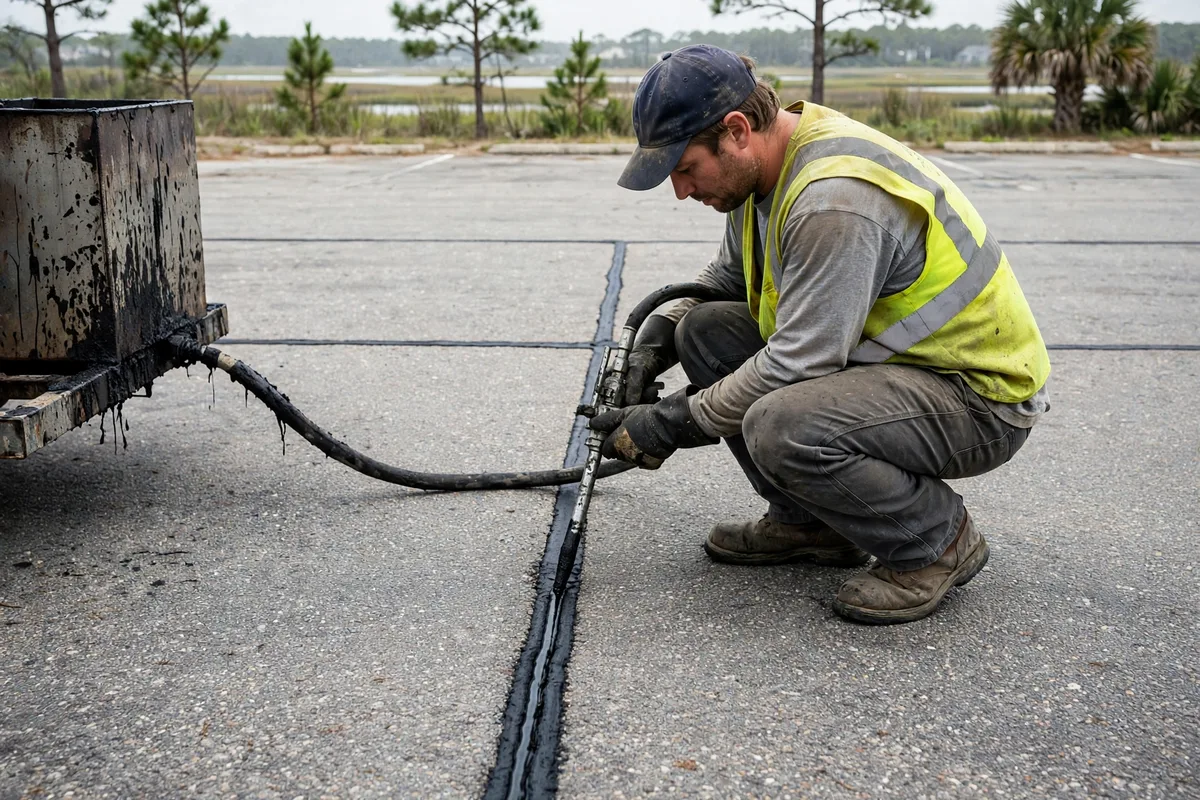
We fill cracks with hot-pour rubberized sealant, routing or cleaning them first. It is priced at $0.50 to $3.00 per linear foot. Where in that range a job lands depends on crack width, how much cleaning each crack needs and whether routing is called for.
A pothole repair runs $150 to $400 per pothole. Larger failed areas are cut and patched, priced by the square foot of area, with size, depth and the condition of the base underneath setting the cost.
Striping jobs run $600 to $3,600. A restripe over an existing layout costs less than laying out a new one, and the number of stalls, aisles and markings sets the rest.
Accessible spaces, access aisles, crosswalks, fire lanes and directional arrows. We paint the markings to the layout you give us and do not certify compliance with any code. The price follows the number and type of markings, and it often rides along with a striping job.
An add-on to striping and lot work. We set signs and wheel stops while the crew is already on your lot, not as a separate project.
Sealcoating, crack sealing, patching and striping on one recurring plan for retail, office, church, HOA and amenity lots. Each piece is priced by its own band above, so the plan adds up from numbers you have already seen.
For drives that have cracked, sunk or broken at the edges. Most worn driveways are repair candidates, and we say so when the base is sound. Repairs are priced by the area and depth involved, and we look at the drive before we name a figure.
What it costs
These are the figures we work from. The number comes first, and the visit confirms where on the band your pavement falls.
| Work | Price | What moves it |
|---|---|---|
| Sealcoating, residential | $0.15 to $0.25 per square foot | Size, surface condition, prep |
| Sealcoating, commercial | $0.20 to $0.40 per square foot | Lot size (large lots toward the low end), number of coats, sealer grade, prep |
| Driveway sealcoating, typical job | $600 to $2,000 | Size, crack filling, oil-spot priming, minimum fee on small drives |
| Crack sealing | $0.50 to $3.00 per linear foot | Crack width, cleaning or routing, total footage |
| Pothole repair | $150 to $400 per pothole | Size, depth, base condition |
| Line striping | $600 to $3,600 per job | Number of stalls and markings, restripe versus new layout |
Prep work is where two similar-looking jobs end up at different prices. A driveway with a dozen hairline cracks and a few oil drips costs less than one with wide cracks, algae on the shaded side and a drip stain under every vehicle. On a lot, crack sealing, cleaning and oil-spot priming are priced alongside the coating and not folded into it, so you can see what each piece costs.
When you call, give us the rough size and what you see on the surface. We can usually tell you which part of a band you are in before we arrive. The visit confirms it.
How a visit goes
The steps run in the same order on a driveway or a church lot. Only the scale changes.
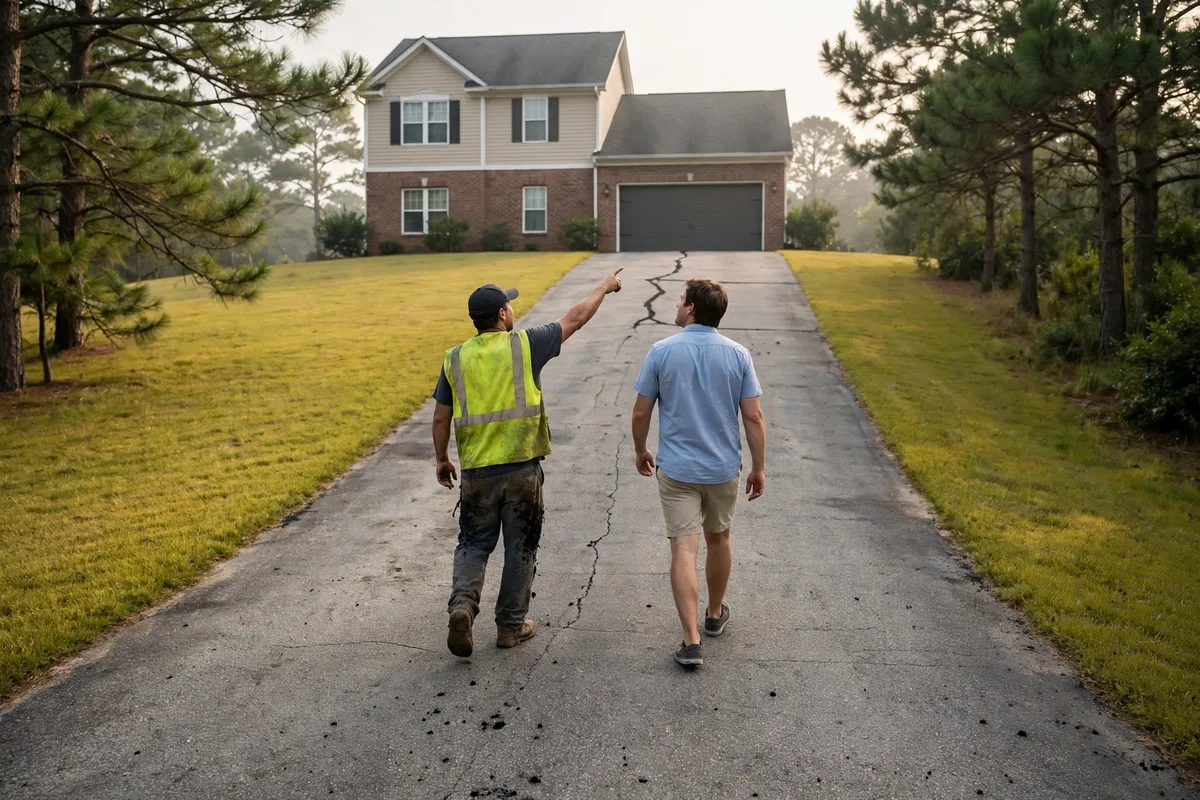
1. Walk the pavement
We walk the whole surface with you, looking before we touch anything. We note where cracks run, where the surface has gone gray and rough, where oil has softened it and where water stands after rain.
2. Measure and mark
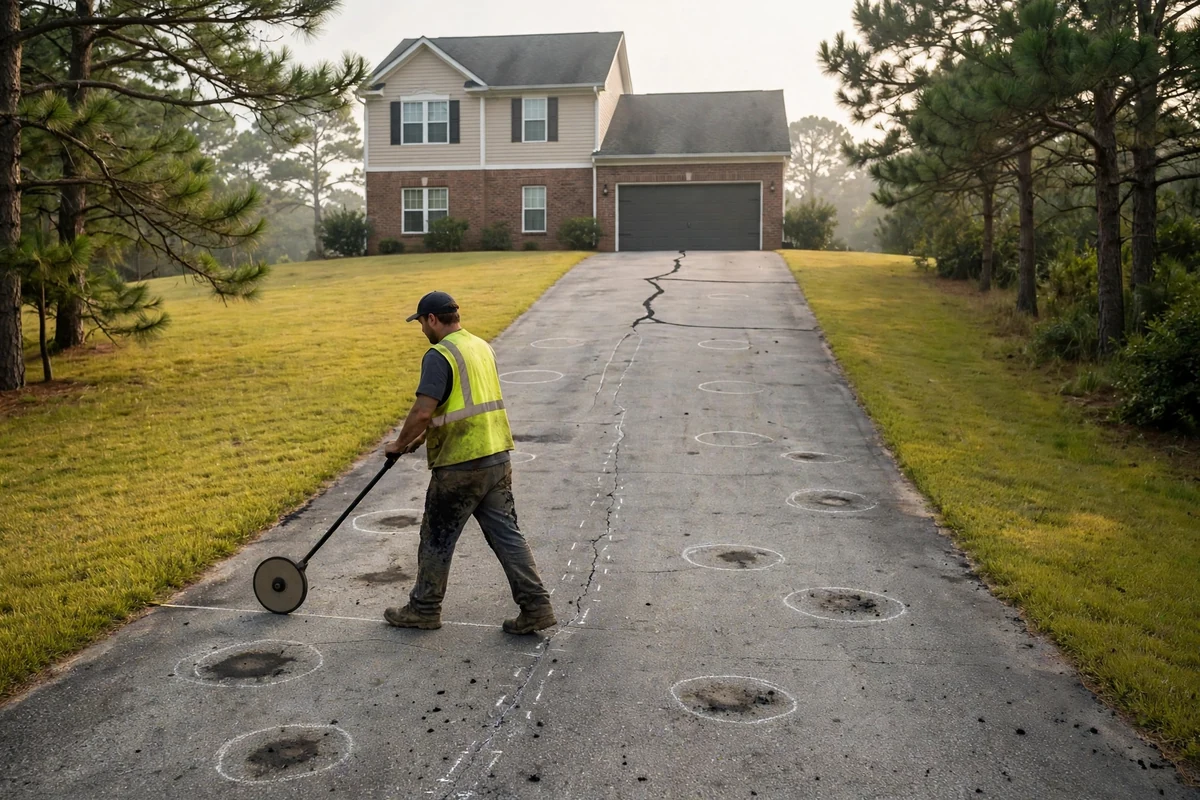
We measure the area with a wheel and mark the cracks, patches and oil spots in chalk or paint. Square feet, linear feet of crack and the count of failed spots are what the prices are built from.
3. Clean the surface
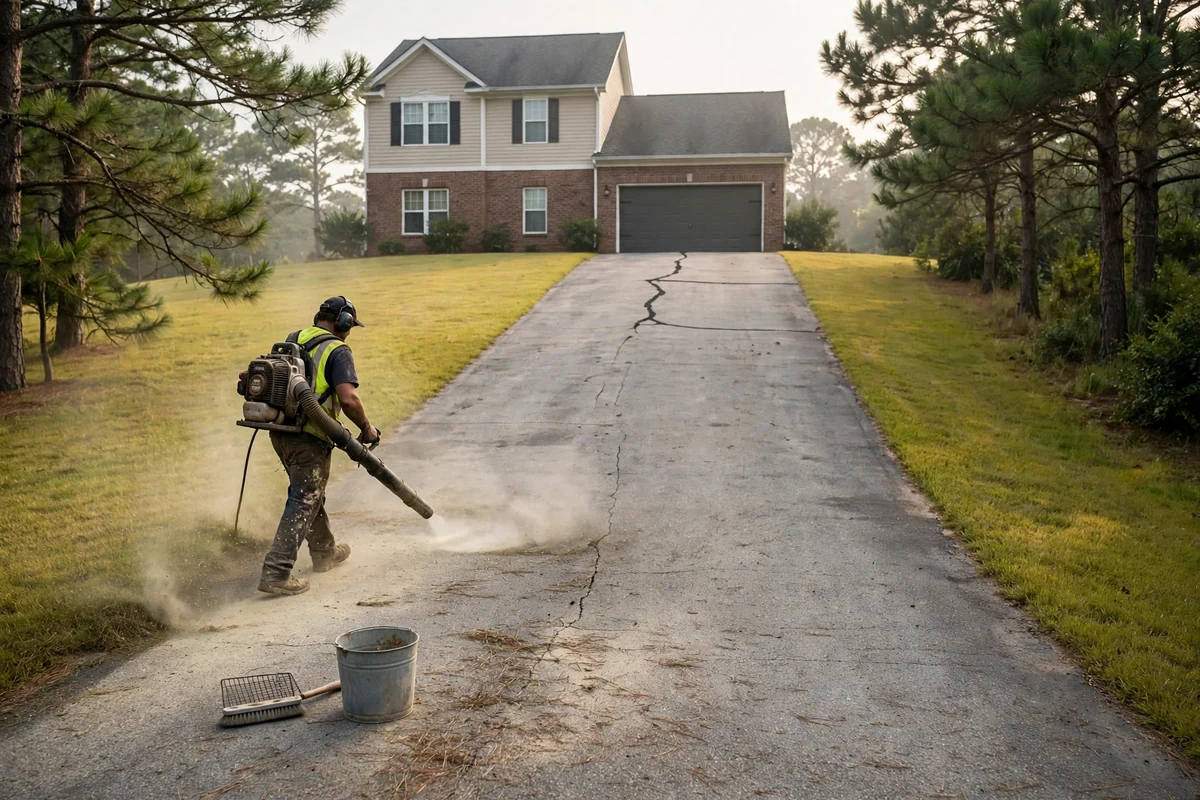
Sealer bonds to clean asphalt and nothing else. We blow and brush off sand, leaves and loose debris, and scrub oil and grease spots. Sand gets everywhere in Brunswick County and has to come off before anything goes down.
4. Repair before coating
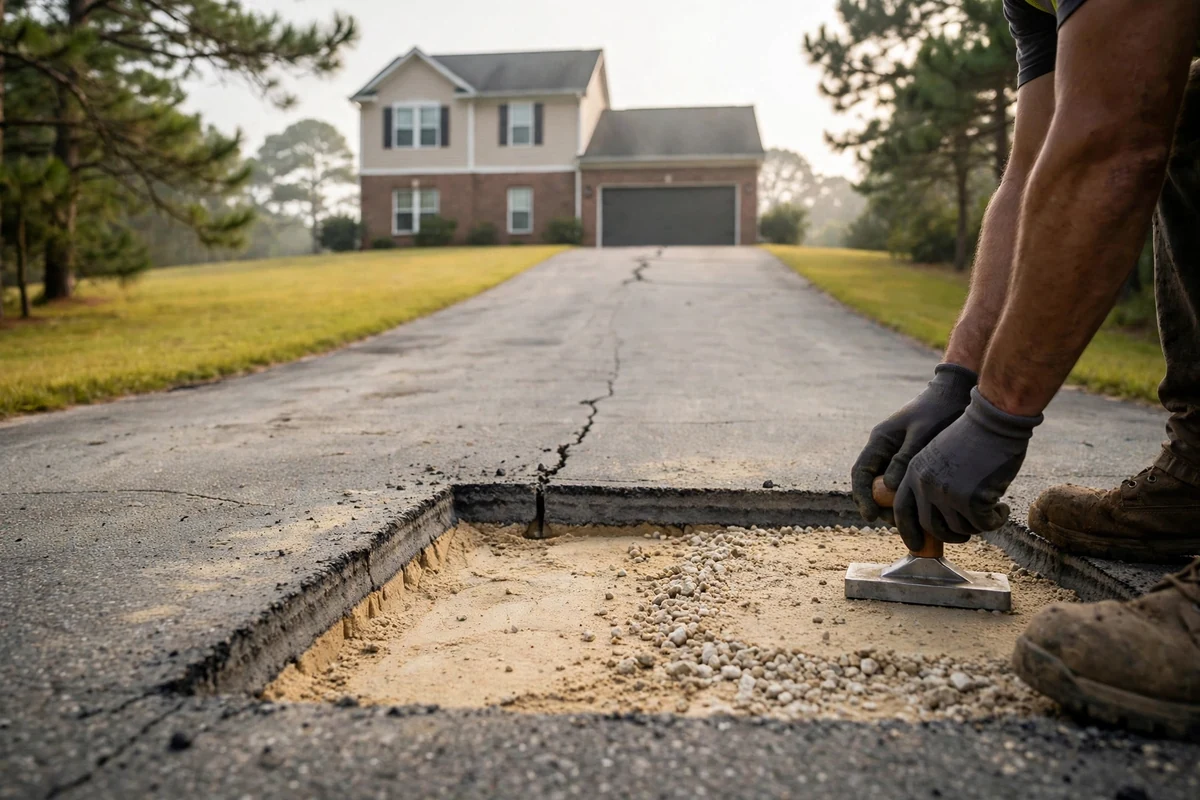
Cracks get routed or cleaned and filled with hot-pour rubberized sealant. Failed spots are cut out square, the base is rebuilt and hot-mix asphalt is compacted in. We do this first because a coating over an open crack just covers the way water gets in.
5. Prime and sealcoat
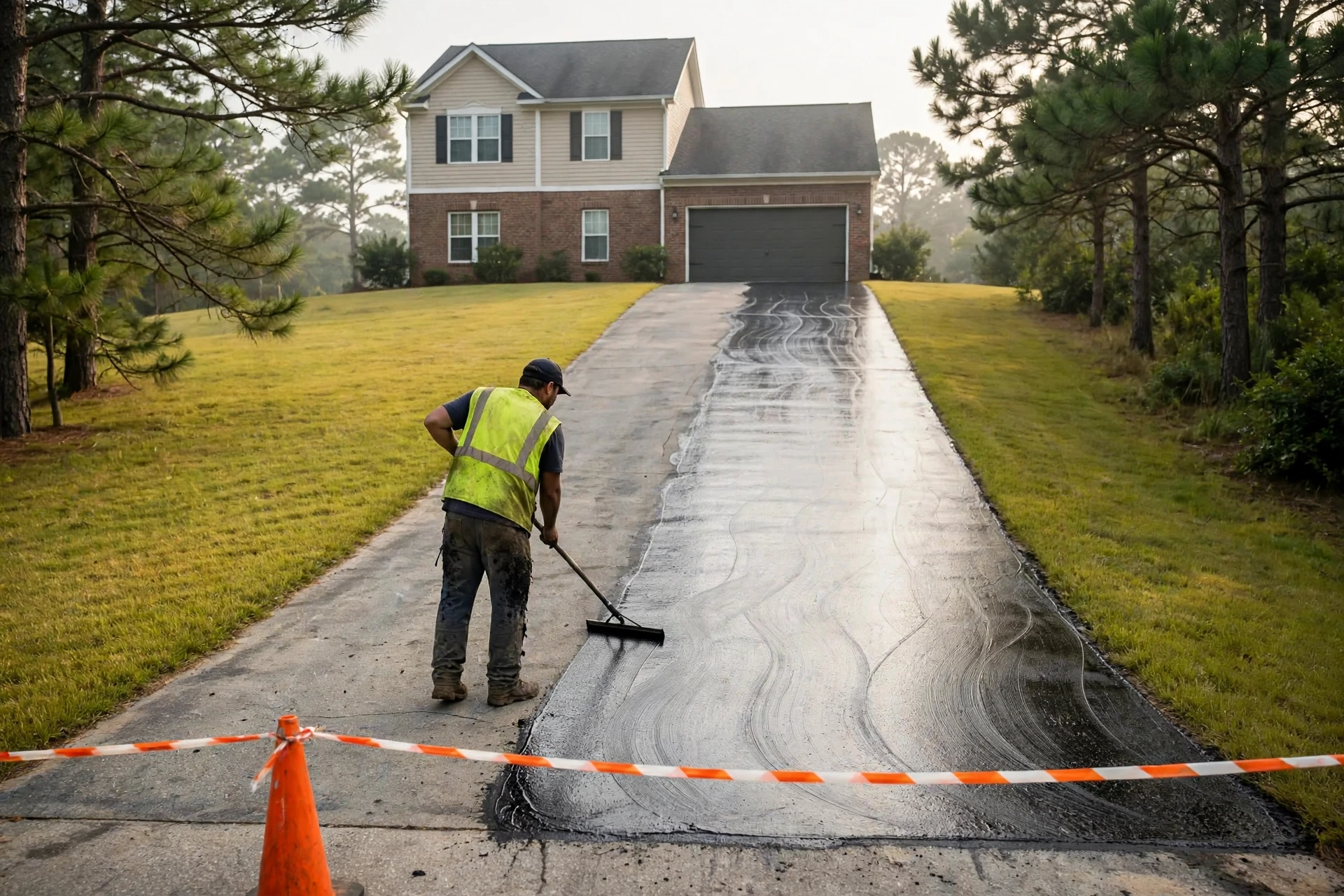
Oil spots are primed so the sealer holds over them. Then we cut in the edges by hand and coat the open area by spray or squeegee. Commercial lots get two coats. We barricade the work and tell you how long to stay off it. Sealing needs dry weather, so rain moves the day.
6. Stripe, then walk it with you
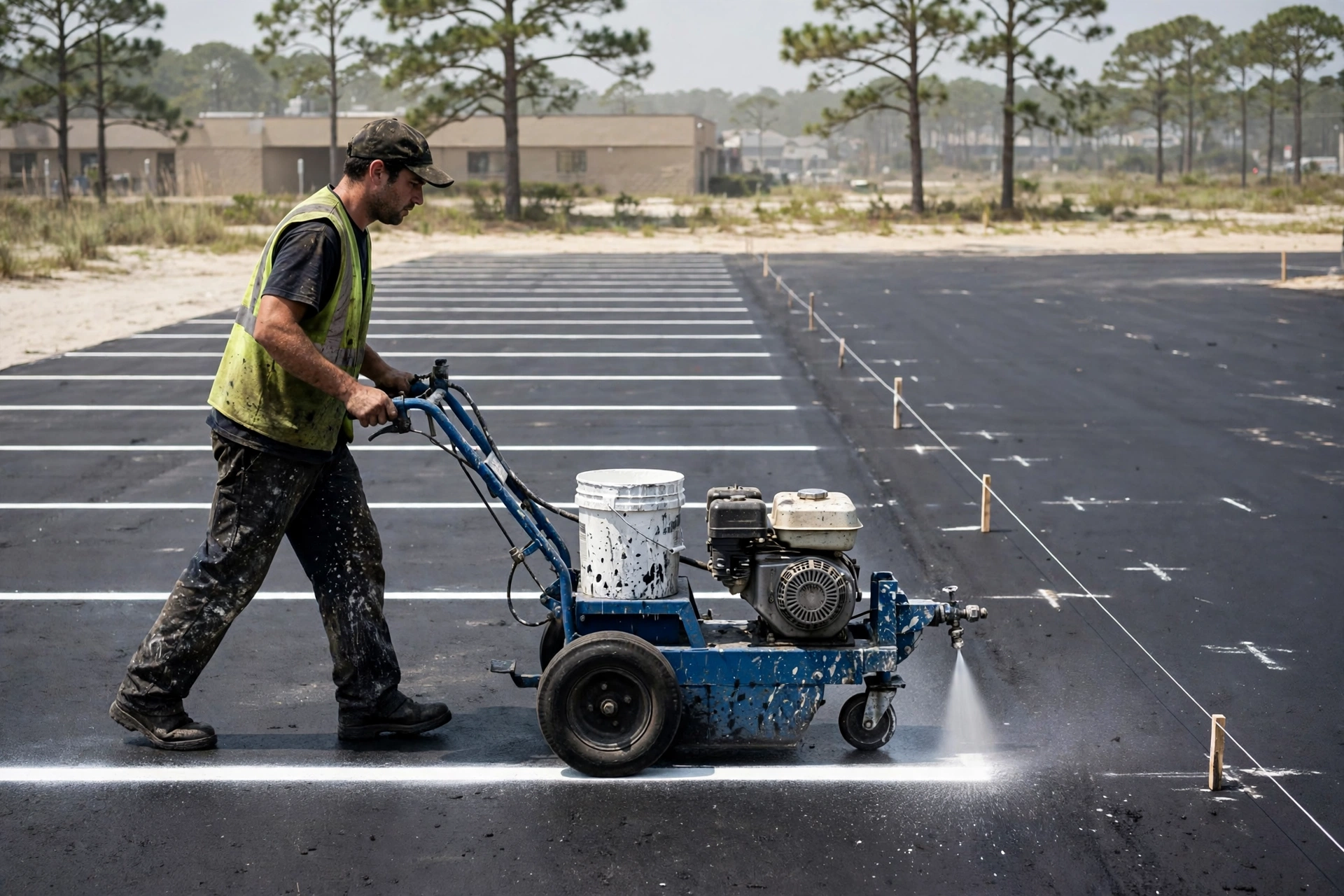
On lots, markings go on after the sealer has cured. We lay out the stalls and aisles from your existing layout or a new one, and we paint with waterborne traffic paint. Before the crew leaves, we walk the finished work with you and point out what to watch.
The amenity-center lot at a Leland master-planned community
The lot served a pool and a clubhouse at one of Leland's master-planned communities, and it had gone the way many do in this climate. The surface was gray and rough from sun and salt air. Cracks had opened at the joints and across the drive aisle, and the water that ran into them after each storm was working on the base. There were oil drips where residents were dropped off by the clubhouse door, and the stall lines had faded until the lot looked tired.
The board's concern was timing. The pool and clubhouse had to stay open to residents, and a lot closed for several days would not do that. We split the job across two Sundays and worked the lot in sections so the crew and barricades took only part of it at a time.
On the first Sunday the crew blew off and brushed the whole surface, scrubbed the oil spots, and filled the cracks with hot-pour rubberized sealant. Oil spots were primed. Then the sealer went on in two coats, cut in by hand at the edges and curbs, with barricades at each section until it had set.
The second Sunday was the restripe. With the sealer cured, we laid the stalls and aisles back over the original layout in waterborne paint, so every space sat where residents expected it.
The price came straight from our bands. Sealcoating was priced at the commercial rate of $0.20 to $0.40 per square foot, crack sealing at $0.50 to $3.00 per linear foot, and the restripe inside the $600 to $3,600 striping range. The size of the lot and the footage of cracking set where each landed.
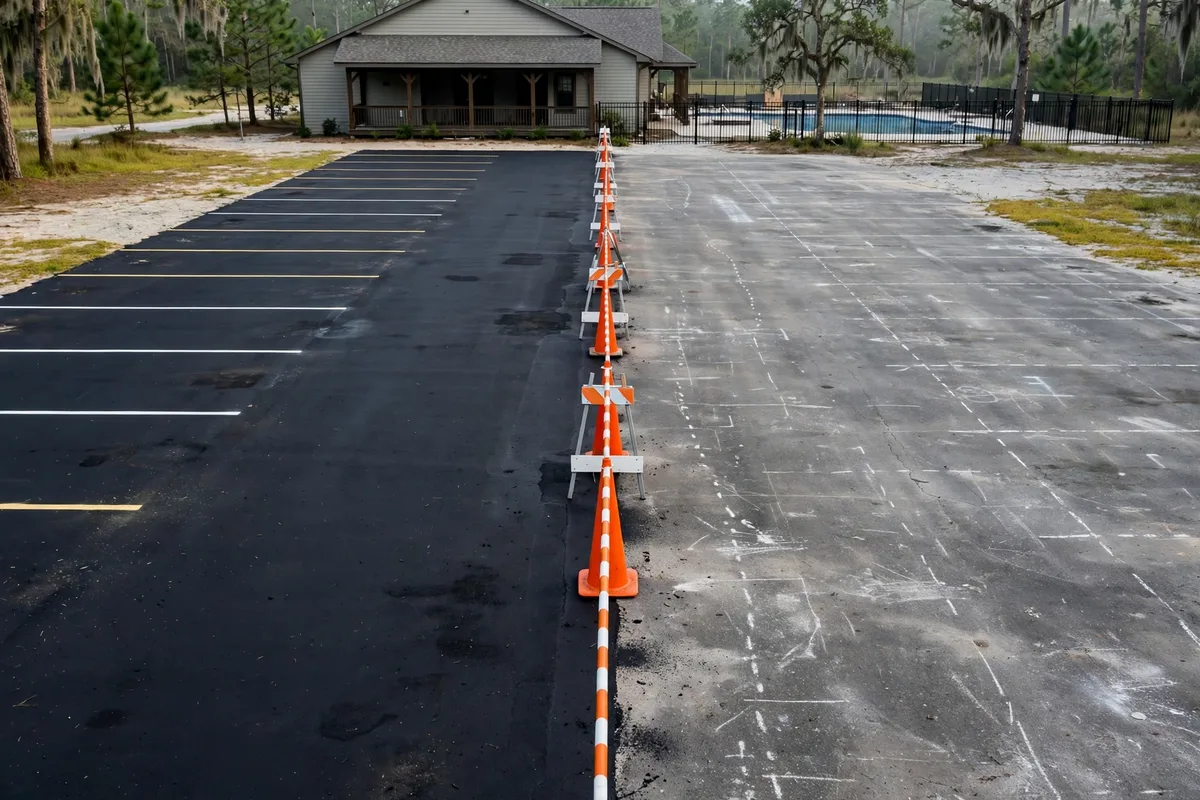
What to watch after a job like this: look at the joints and drive aisle a few weeks after the first hard rain, and call if a crack has reopened. Check the drop-off area for new oil, since that is where drips return first. The lot is due for another look when the surface starts to turn gray again.
Two more jobs
A Waterford driveway. A driveway beside one of the canals had gone gray, with hairline cracking through the middle and a dark oil stain where a car had parked for years. We filled the cracks, primed the stain, and sealcoated the drive with the edges cut in by hand. The job fell within the $600 to $2,000 band for driveway sealcoating.
A Village Road retail lot. A small retail lot on Village Road had faded stalls and a handful of open cracks along the front row. The crew sealed the cracks, coated the lot at the commercial rate and restriped it over the existing layout, the same order as the community lot above, only smaller.
Why asphalt needs maintenance here
Asphalt is a maintained surface, not a permanent one. On this coast four things wear it down, and each has its own fix.
UV oxidation. Heat, humidity and hard sun dry out the binder that holds the stone together. The black surface turns gray and rough, and small stones start to loosen. Sealcoating addresses this.
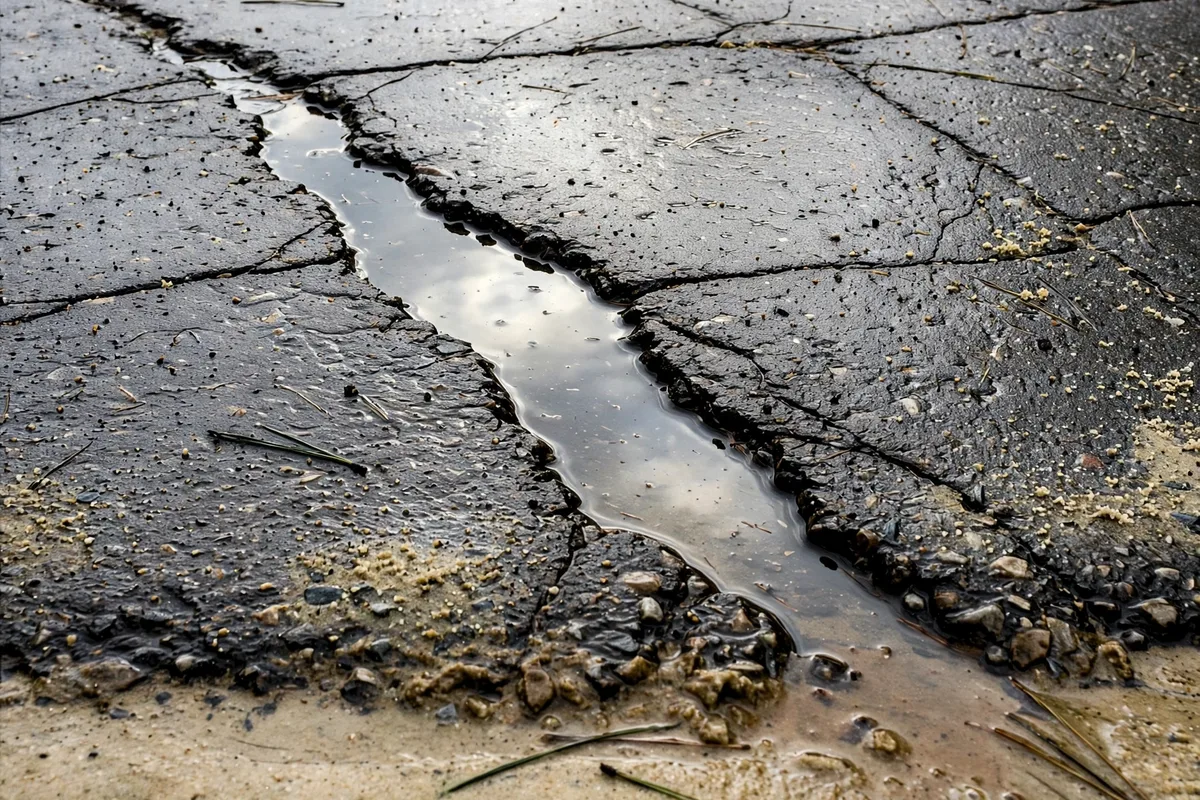
Water through cracks. Summer thunderstorms and tropical systems can drop inches of rain at once. Water that finds an open crack gets under the surface and softens the base. Crack sealing keeps it out.
Oil and fuel softening. Drips from engines dissolve the binder in the spot where a vehicle parks. The surface goes soft and pits. Sealcoating over primed oil spots addresses this.
Sandy base failure. Brunswick County soil is sand with a high water table, so what is under a driveway or lot decides how long it holds up. When the base washes out or settles, the surface cracks and sinks. Cut-and-patch repair rebuilds that base.
Hurricane Florence in 2018 flooded this county badly, and storm-season wear on drives and lots is a fact of life here. Most owners reseal every two to three years as typical practice. The right interval depends on your pavement, and we do not promise a lifespan for any coating or surface.
Who runs the work
Derek Sandlin is our operations manager. He keeps jobs on schedule and sees that the work matches what was agreed with you. You can read more about him and how we work on the About page.
Where we work
Leland is our center. The town has grown from 22,908 people at the 2020 census to 35,731 in the Census QuickFacts figure for 2025, and Brunswick County is North Carolina's fastest-growing county. That growth is mostly master-planned communities built since the 2000s, so their driveways and community lots are reaching maintenance age together.
We work in Brunswick Forest, with its 4,500 acres, the Cape Fear National golf course, the wellness center and the Villages town center. We work in gated Compass Pointe, in established Magnolia Greens, and in Waterford with its lakes and canals. Along US-17 and Village Road, the commercial corridor is growing as fast as the rooftops.
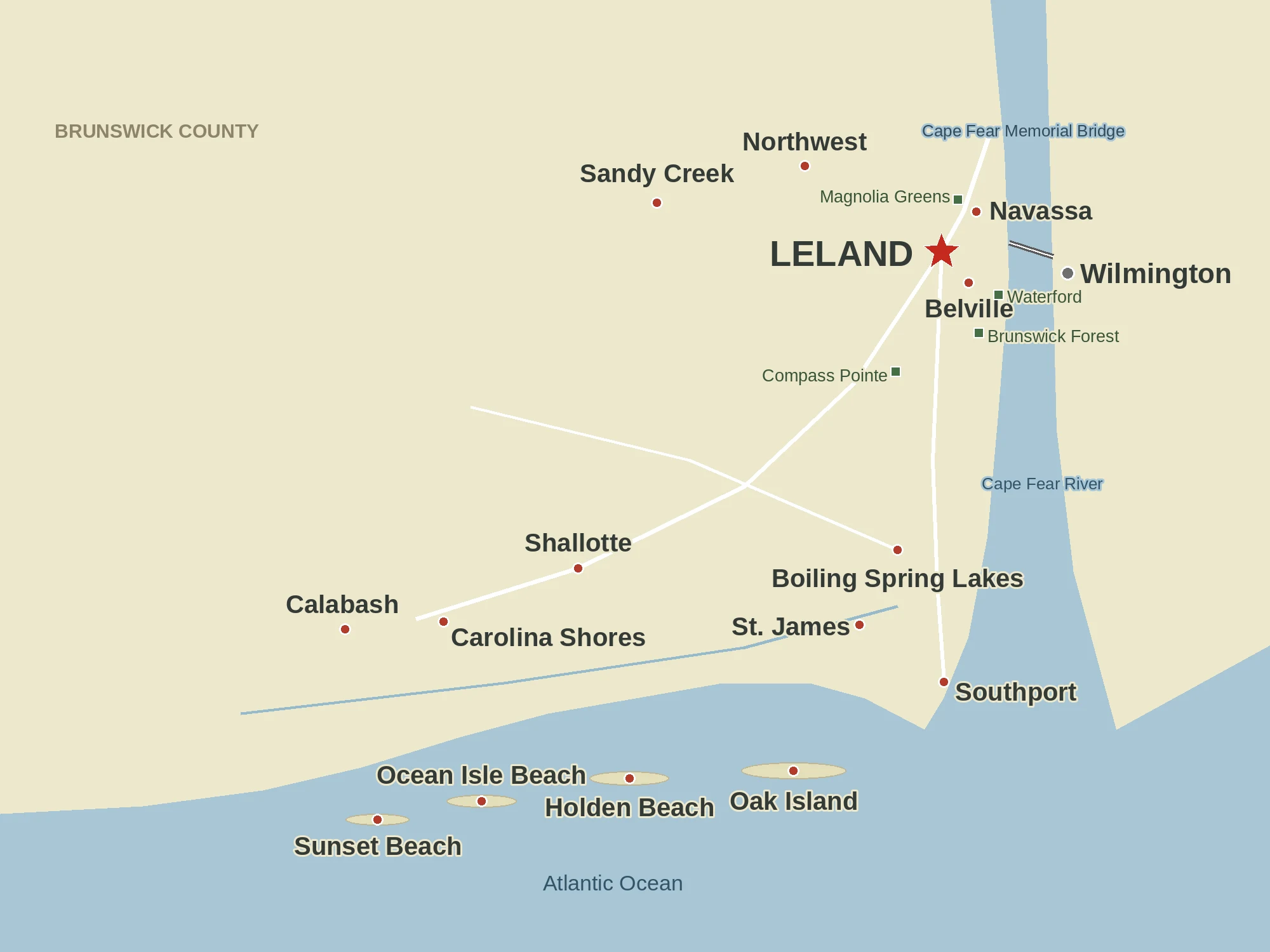
Beyond Leland we serve the road-connected towns of Brunswick County: Belville, Navassa, Northwest, Sandy Creek, Boiling Spring Lakes, Southport, Oak Island, St. James, Shallotte, Holden Beach, Ocean Isle Beach, Sunset Beach, Calabash and Carolina Shores. Sunset Beach, Calabash and Carolina Shores sit about 50 minutes out, at the far edge of where we work. Wilmington is served ground, about 10 minutes across the Cape Fear Memorial Bridge. Bald Head Island is not part of our service.
Questions
What does Leland Pavement Care do?
We maintain and repair asphalt: sealcoating, crack sealing, pothole repair and patching, line striping and pavement markings, signs and wheel stops as an add-on, and maintenance programs. We work for homeowners, businesses, HOAs and churches in Leland and across Brunswick County.
Do you pave new driveways or parking lots?
No. We care for existing asphalt. We do not lay new lots or roads, mill pavement, pour concrete or do drainage work, and we do not bid municipal road work.
How much does driveway sealcoating cost?
Most home driveways cost between $600 and $2,000. Size sets the price first. Cracks that need filling and oil spots that need priming add to it, and small drives carry a minimum fee. Residential sealcoating runs $0.15 to $0.25 per square foot.
How much does parking lot sealcoating cost?
Commercial sealcoating is $0.20 to $0.40 per square foot, and large lots price toward the lower end. Crack sealing, cleaning and oil-spot priming are priced on top of that. Commercial lots get two coats.
How much does crack sealing cost?
Crack sealing is $0.50 to $3.00 per linear foot. The price depends on how wide the cracks are, how much cleaning or routing they need and how many feet there are in total. We use hot-pour rubberized sealant.
How much does a pothole repair cost?
A pothole repair runs $150 to $400 per pothole. Larger failed areas are cut and patched and priced by the square foot, with size, depth and the condition of the base setting the price.
How much does line striping cost?
Striping jobs run $600 to $3,600. A restripe over an existing layout is less work than a new layout, and the number of stalls, aisles and markings sets the rest.
How often should I sealcoat?
As typical practice, most owners reseal every two to three years. That is a rule of thumb, not a guarantee. The right timing depends on how the surface is wearing, and we look at that on the visit.
What do you do before sealcoating?
We clean the surface, fill the cracks, repair failed spots and prime the oil stains. Sealer bonds only to clean, sound asphalt, and skipping this work is why coatings peel.
Can the lot stay open while you work?
Often it can, with planning. On a Leland community lot with a pool and clubhouse we worked over two Sundays, in sections, so the amenities stayed open. Tell us when your lot needs to be in use and we will plan the sequence around it.
Do you do ADA markings, and are they certified as compliant?
We paint accessible spaces, access aisles, crosswalks, fire lanes and directional markings to the layout you give us. We do not certify legal compliance or guarantee code conformance. That determination is not ours to make.
Do you install signs and wheel stops?
Yes, as an add-on to striping and lot work, while the crew is already on your property. They are not a stand-alone service.
Should I repair my driveway or replace it?
Most worn driveways are repair candidates. If the base is sound, cracks can be filled, failed spots patched and the surface sealed. If the base has failed across the whole drive, we will tell you plainly, because that is beyond what our maintenance and repair work can fix.
Do you serve Wilmington and the beach towns?
Yes. Wilmington is served ground, about 10 minutes across the Cape Fear Memorial Bridge. We also serve the Brunswick County towns listed above, out to Sunset Beach, Calabash and Carolina Shores, about 50 minutes from Leland. We do not serve Bald Head Island.
Are the photos on this site of your actual work?
We use real photography whenever possible. AI-generated images may be used to illustrate concepts, finishes, or design possibilities.
How do I get started, and when can I reach you?
Call (910) 370-1121 Monday to Friday, 9:00 AM to 5:30 PM, or fill in the form below. Tell us the size of the pavement and what you see on it, and we will tell you where the job falls in our prices.
Tell us about your pavement
Call (910) 370-1121 or send the form below, and tell us what you see on the driveway or lot. We will tell you which price band it falls in and set up the visit. If you are not sure what the pavement needs, say that. We can sort it out on the walk.
The more details you give, the better we are able to help you.