A pothole is the last thing you see of a problem that started underneath. Leland Pavement Care does pothole repair on the base first and the hole second, because on Brunswick County's sandy ground a hole filled without dealing with what is under it will open again.
The durable version of asphalt patching is a rebuild, not a plug: cut the damage out square, replace the base, and put in hot mix. It goes hand in hand with crack sealing, since water getting in through cracks is what washes the sand out from under the surface to begin with. Most good asphalt repair comes down to stopping the failure rather than covering it.
It applies to the homeowner with a soft spot at the end of the drive and to the manager responsible for parking lot maintenance at a store, church or HOA amenity center. The thinking is the same for driveway repair and for lots. Once the holes are fixed, asphalt sealcoating goes over sound pavement and does the job it is meant to do.
What we patch, and what we leave alone
We patch potholes, failed patches, broken edges and sunken spots in asphalt driveways, parking lots, access lanes and shared drives. That covers homes, businesses, HOAs and churches across Leland and the road-connected parts of Brunswick County. Wilmington is served too, across the Cape Fear Memorial Bridge.
We do not lay new pavement, mill, pour concrete or do drainage work. We do not bid public road work. If a hole is a symptom of water that has nowhere to go, we will tell you so, and we will repair the pavement the water has already damaged. Fixing the grading or the drain is someone else's trade.
Why holes here are base stories
Asphalt is a thin skin on a base, and the base is what carries the load. In this part of North Carolina the base is sand sitting on a high water table. Sand holds up fine while it stays packed and dry, but it moves when water moves through it.
Here is how most holes happen. Sun and heat oxidize the surface until it turns brittle and cracks. Then summer thunderstorms and tropical systems drop inches of rain at once, and that water goes down through the open cracks. Standing water under the pavement carries sand out and softens what is left. Each tire crossing the spot pumps a little more out. Eventually the skin has nothing under it, and a piece breaks through.
After Hurricane Florence in 2018, Brunswick County learned how much water this ground can hold. Storm season still tests every lot and drive here. Holes tend to show up in the weeks after a heavy one.
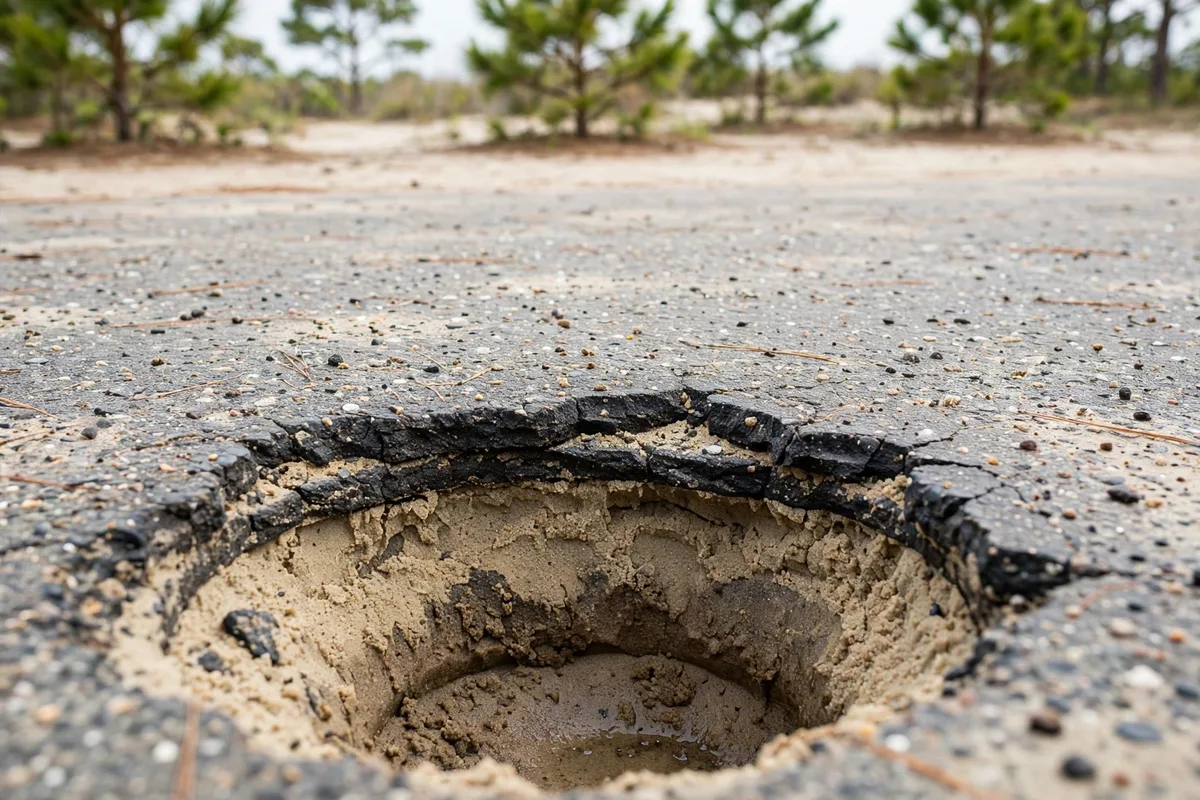
Stopgaps and repairs
There are two kinds of fix, and they should not be confused.
A cold-patch fill is a bagged or loose mix tamped into the hole with no cutting, no base work and no bond to the old edges. A skin patch is a thin layer of new material laid over the damaged area. Both look finished the day they go in. Both can be the right call when you need a lane safe for a few weeks. Neither one reaches the base, and neither one keeps water out at the edges. They buy weeks, not seasons.
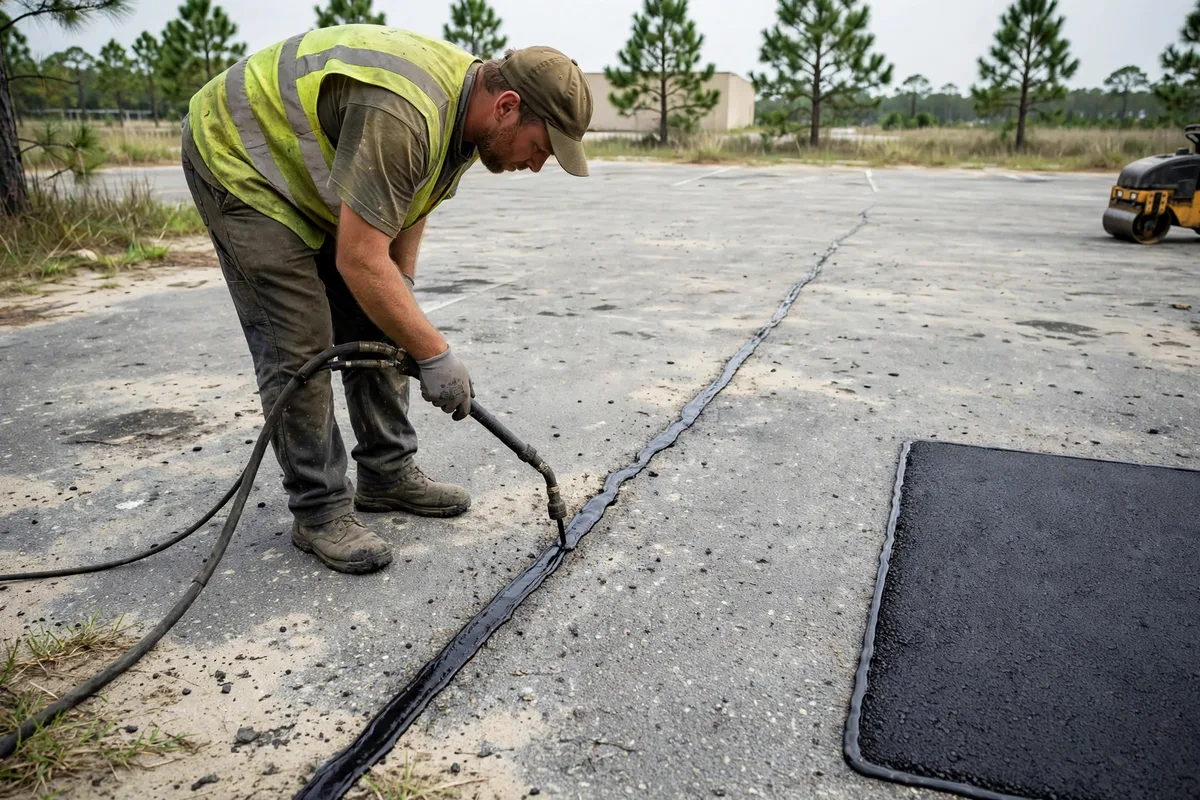
The durable repair is a cut-and-patch with hot mix. We saw-cut the damaged area square, take out everything that failed, rebuild and compact the base, fill with hot-mix asphalt, and seal the edges so water cannot creep in along the seam. Infrared patching exists in the trade, but the repair described on this page is the saw-cut, hot-mix method.
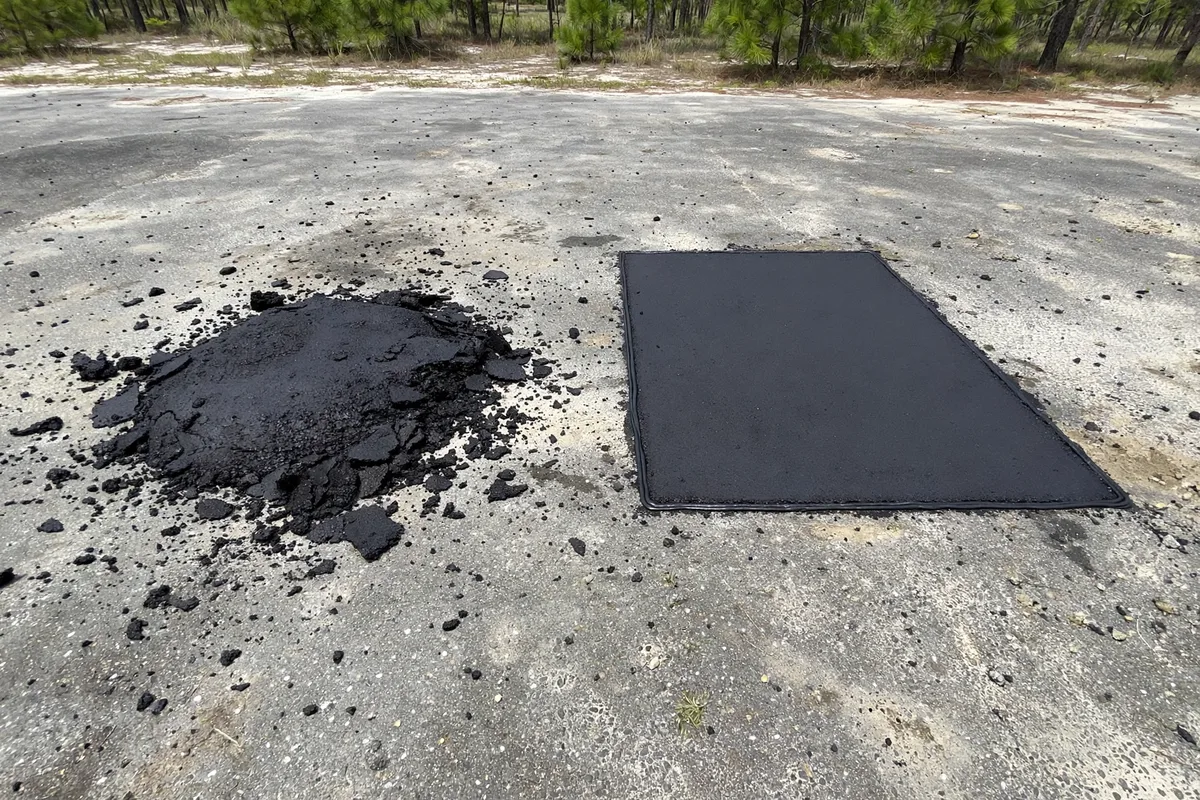
Stopgap or repair?
- What you are looking at: a new hole with solid pavement around it that has not come back before. Stopgap: a cold-patch fill keeps the spot safe for a few weeks, not a season. Honest fix: a saw-cut, hot-mix patch with the base checked and compacted. Standard potholes are $150 to $400 each, depending on size and depth.
- What you are looking at: a hole that was filled before and has opened again. Stopgap: another fill will fail the same way, because the base under the old fill never changed. Honest fix: saw-cut square past the damage, remove the failed material, re-base and compact, hot-mix patch, and seal the edges. Standard potholes are $150 to $400 each, depending on size, depth and base condition.
- What you are looking at: a hole with cracks running toward or away from it. Stopgap: patching the hole alone leaves open cracks that feed it water. Honest fix: patch the hole first, then seal the cracks with hot-pour rubberized sealant. Crack work is $0.50 to $3.00 per linear foot, and sealcoating comes after the patching and the crack work.
- What you are looking at: pavement that gives underfoot or flexes when a vehicle crosses it, sometimes with water or fine sand squeezing up through cracks. Stopgap: a skin patch or cold fill will be crushed in the first weeks. Honest fix: a cut-and-patch across the whole soft area, taken down to firm base, re-based and compacted, then filled with hot mix. Area work is priced by the square foot, and the drivers are size, depth and base condition.

How the work goes
Every patch follows the same order. Skipping a step is how a patch ends up as a stopgap.
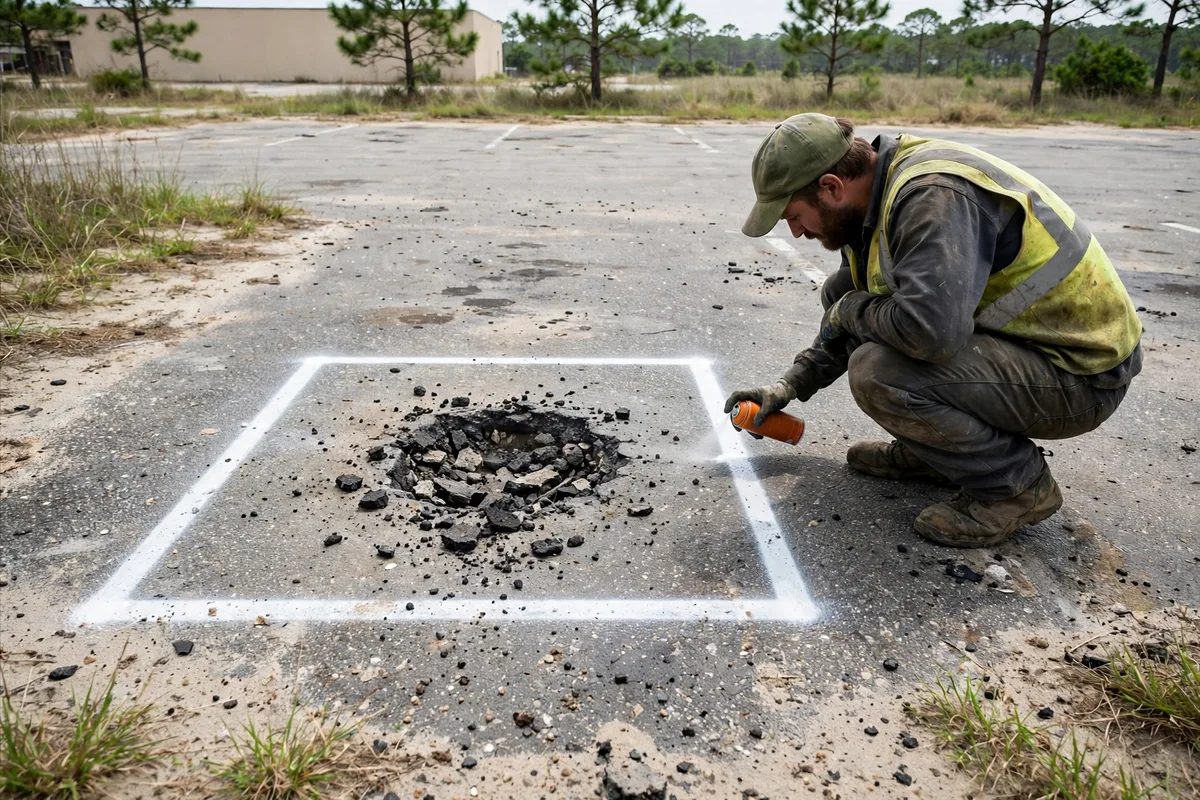
1. Walk the area and mark it. We look at each hole, then at the pavement around it. We press on the surrounding asphalt, look for cracks, check for soft or spongy ground and look at how water moves across the spot. The marking line is drawn past the visible damage, because the failure under the surface is always wider than the hole.
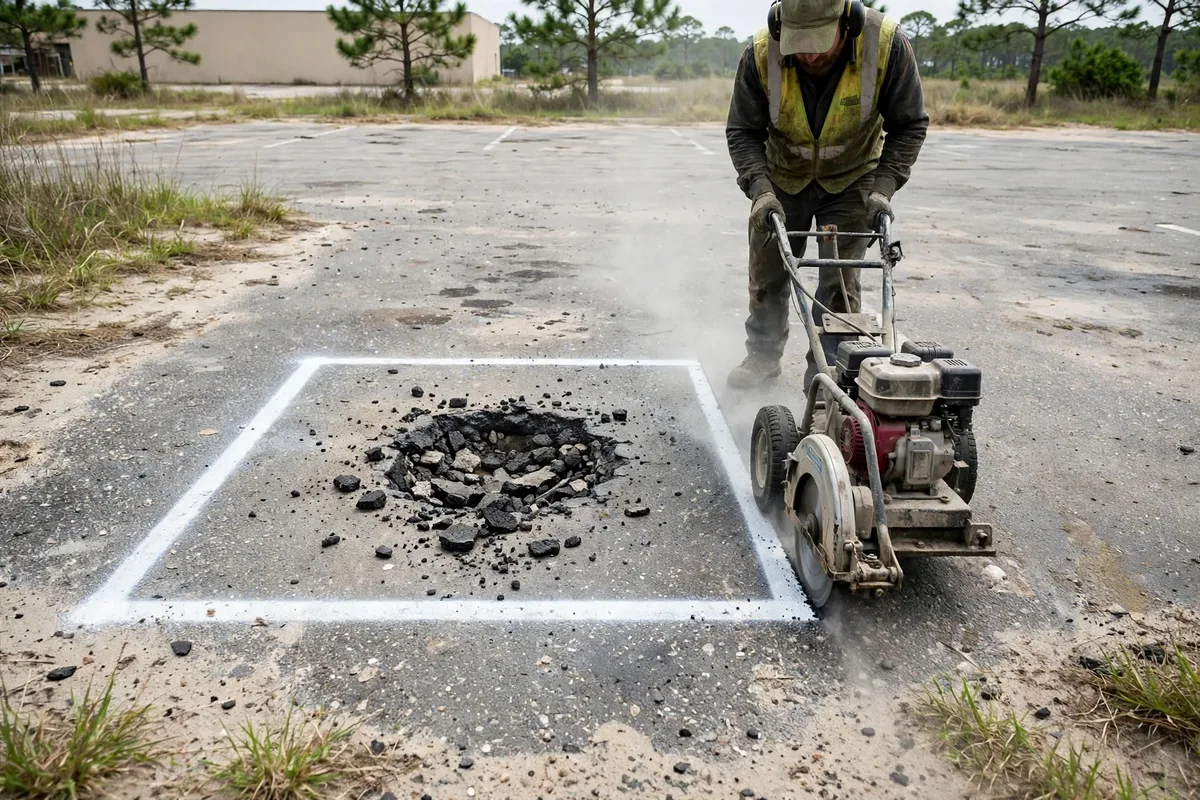
2. Saw-cut square. A saw cuts along the marked line to a clean, vertical edge. Square cuts give the new hot mix a straight face to bond against, where a ragged break would not.
3. Remove the failed material. The cut asphalt comes out, along with whatever loose, wet or contaminated material sits below it. We dig until we reach firm ground. If we hit soft sand, we keep going.
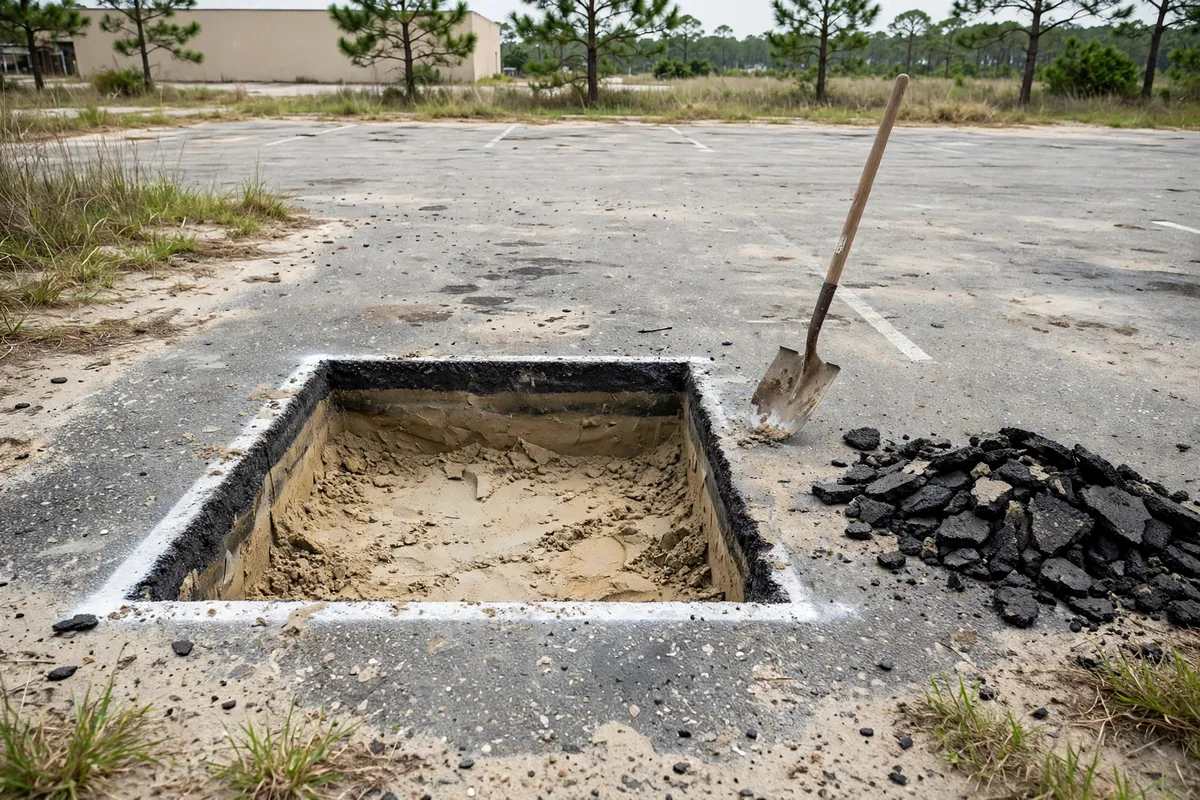
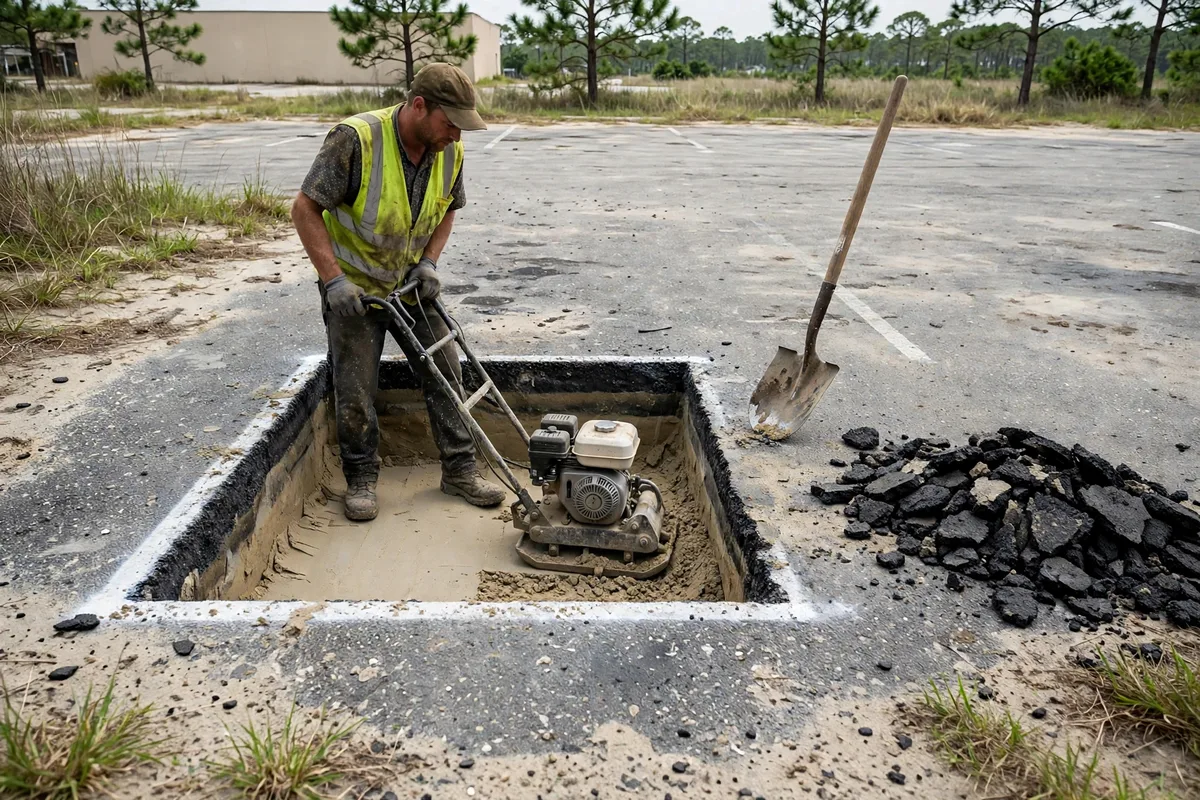
4. Re-base and compact. Fresh base material goes in and is compacted until it is firm underfoot. In sand, compaction is the whole difference between a patch that holds and one that settles.
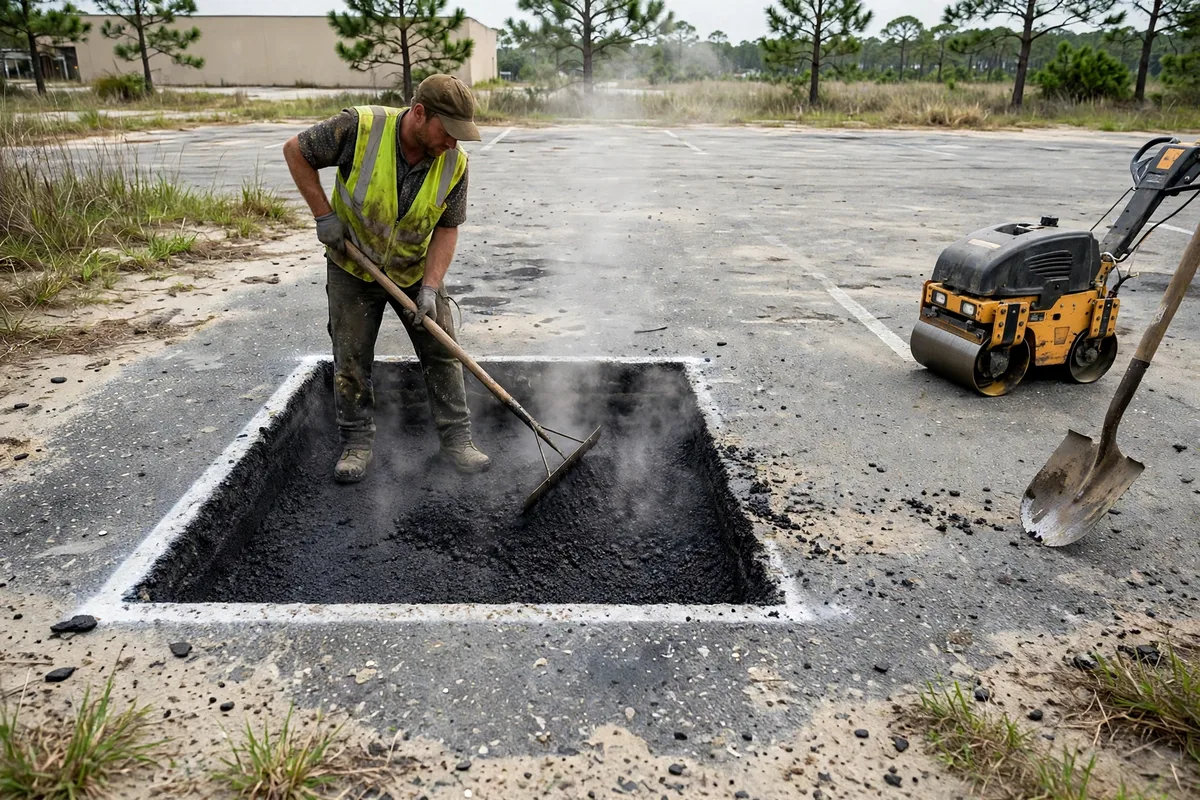
5. Hot-mix patch. Hot-mix asphalt is placed in the cut, raked level to the surrounding pavement and compacted. Hot mix bonds to the cut edges and stays flexible, which a cold fill never does.
6. Seal the edges. The seam where new meets old gets sealed. That joint is where water tries to get back in, and sealing it protects the base we just rebuilt.
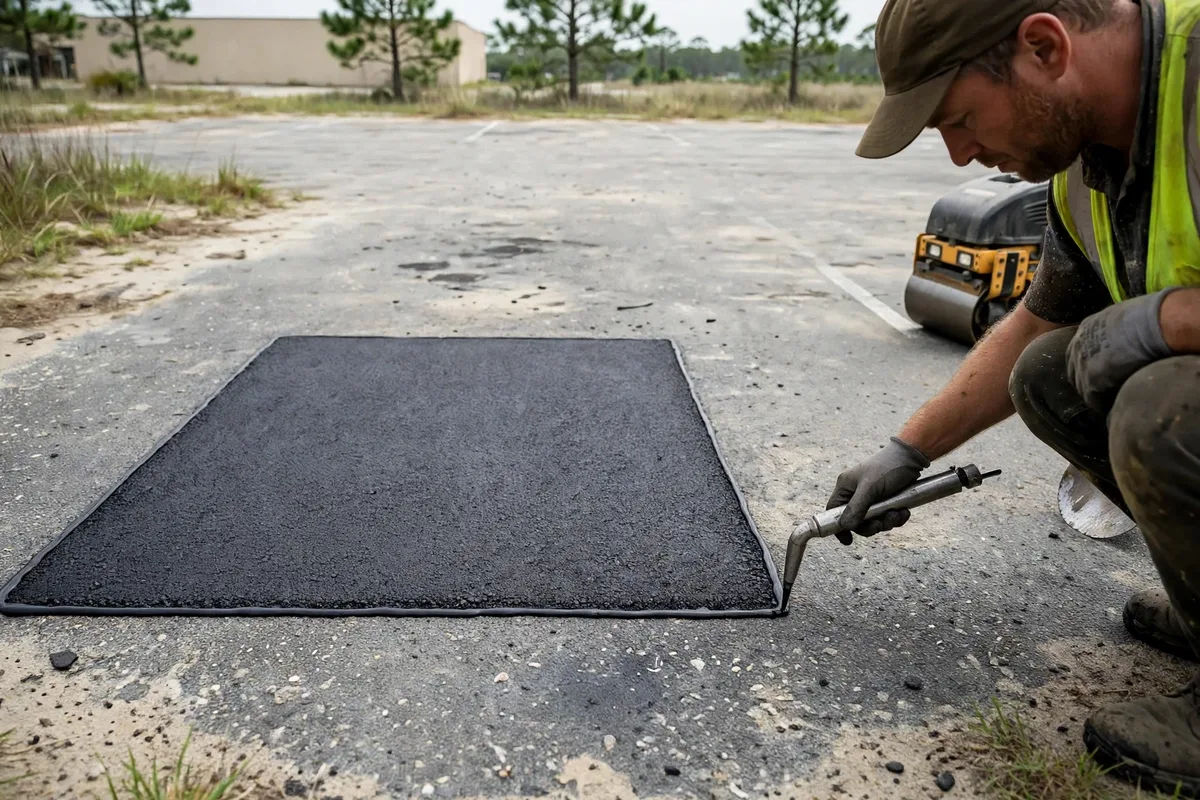
7. Seal the cracks nearby. Any cracks around the patch get cleaned and filled with hot-pour rubberized sealant. If the cracks stay open, water finds the next weak spot and the next hole is already forming.
Patch first, coat after
Sealcoating is a surface treatment. It slows UV oxidation and shields the pavement from oil and fuel. It does not fill holes, bridge cracks that move, or firm up a soft base. Put coating over a bad patch and you have a shiny, failing patch.
So the order is patching, then crack work, then sealcoating. A repaired, sealed surface takes coating evenly and looks the same from edge to edge. Fresh patches also show up darker for a while, and a coat evens that out. Most owners reseal every two to three years as typical practice, and the patching is done before the next coat goes on.
What pothole and patching work costs
A standard pothole repair is $150 to $400 per pothole. Where a price lands inside that range depends on how large the hole is, how deep it goes, and what shape the base is in. A shallow hole in firm ground sits toward the low end. A deep hole with a wet, soft bottom takes more digging, more base and more time.
Larger damaged areas are priced differently. When a section of drive or lot has gone soft or alligatored, we cut and patch the whole area, and that is priced by the square foot on the area. Size, depth and base condition drive that price too.
Cracks near the patch are priced separately at $0.50 to $3.00 per linear foot for hot-pour rubberized crack work. Cleaning and oil-spot priming are priced on top when a surface needs them before coating.
The entrance lane on Village Road after storm season
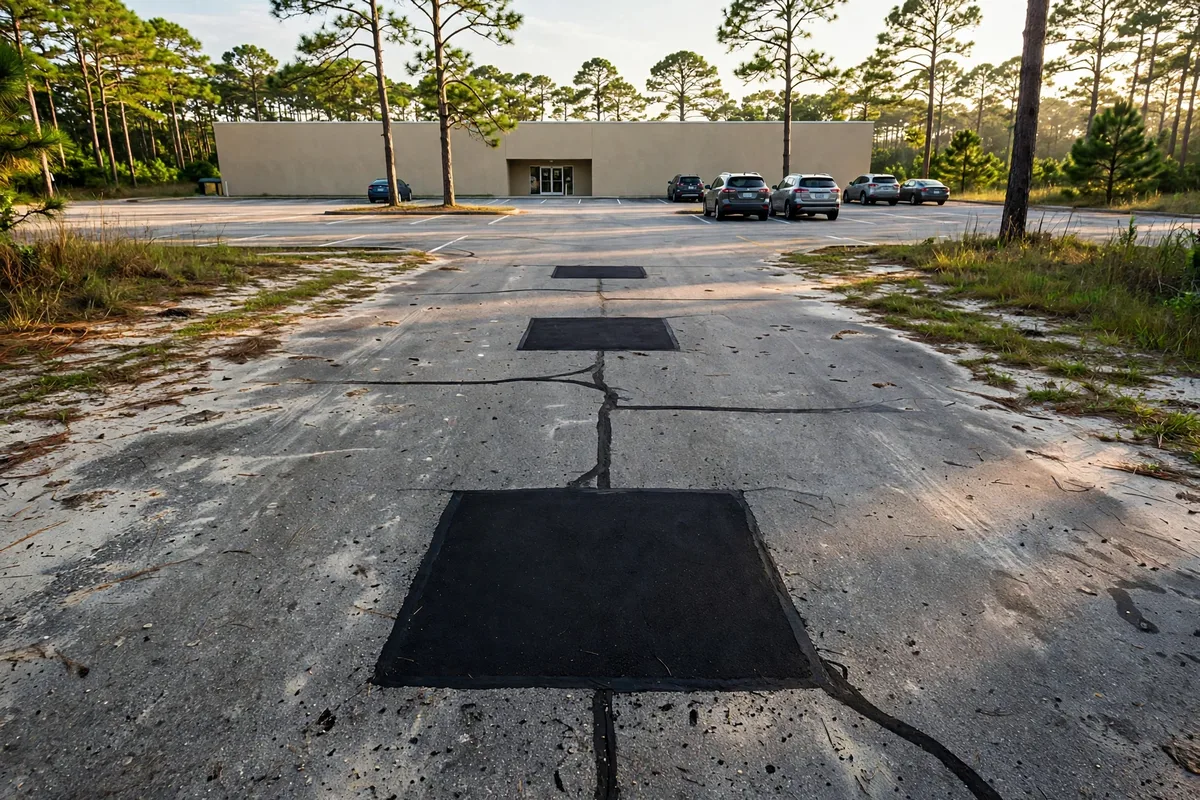
The lot belongs to a grocery-anchored shopping center on Village Road, and the problem was in the entrance lane. Every delivery truck and every customer car crosses that lane. After storm season it had three holes in it. Each one had been filled before and had opened again.
The crew walked the lane first. Three recurring holes in a lane that takes that traffic pointed at the base, and when they pressed along the edges of each hole the pavement around them was not as solid as it looked. Cracks ran from the holes along the lane. Those cracks were the path the storm water had taken.
For each hole, the crew marked a square past the visible damage and saw-cut it. They pulled out the failed asphalt and the loose, wet sand beneath it, dug down to firm ground, rebuilt the base and compacted it. Hot mix went in, was raked flush and rolled. The seams were sealed. With the three patches in, the crew cleaned the cracks in the rest of the lane and filled them with hot-pour rubberized sealant.
The three holes were priced as standard potholes at $150 to $400 each, with size, depth and base condition setting each one inside that range. The crack work was priced per linear foot at $0.50 to $3.00.
What to watch for on a job like this: the seams around each patch, new cracking beginning at a patch edge, and any spot where the lane feels soft or water stands after rain. If one of those appears, it is better to look at it early than to wait for the next storm to open it.
Questions
How much does pothole repair cost?
A standard pothole is $150 to $400 each. The price depends on the size of the hole, how deep it goes and what the base looks like once the failed material is out. Larger damaged areas are cut and patched and priced by the square foot on the area.
Why does my pothole keep coming back?
Because the fix never reached the base. If the hole was filled with cold patch or a skin patch, the sand underneath was still loose or wet, and the water path through the cracks was still open. The next heavy rain or the next few hundred tires opens it again.
Is cold patch ever the right choice?
Yes, as a stopgap. If a hole needs to be safe for a few weeks until it can be repaired properly, a cold-patch fill can do that. It will not last a season, and it does not stop the water that made the hole.
What is the difference between a skin patch and a cut-and-patch?
A skin patch lays a thin layer over the damaged area and does not remove anything. A cut-and-patch is saw-cut square, dug out to firm ground, re-based, compacted and filled with hot mix. One covers the problem and the other fixes it.
How long will a patch last?
We do not promise a number of years, and nobody honest can on sandy ground. How long a patch holds depends on the base, how well water stays out of the area, and the traffic on it. What we can say is that a rebuilt base with sealed edges and sealed nearby cracks is built to last far longer than a fill.
Do you patch driveways as well as parking lots?
Yes. We patch residential driveways, shared lanes, business lots, church lots and HOA amenity lots. The method is the same. The scale is not.
Do you do something about the cracks too?
Yes, and we recommend it. Cracks near a patch are how water gets back under the pavement. We clean them and fill them with hot-pour rubberized sealant, priced at $0.50 to $3.00 per linear foot.
Should I patch before sealcoating?
Always. Sealcoating protects a sound surface and does not repair a failed one. The order is patching, crack work, then the coat, and the coat goes over everything evenly.
How do I know if my base is bad?
A soft spot, a spot that flexes when a vehicle crosses it, fine sand or water pushing up through cracks after rain, and a hole that returns after being filled are all signs. We press and look at the pavement around the damage before we mark anything.
Can you fix a wide sunken or soft area, not just one hole?
Yes. That is area cut-and-patch work, priced by the square foot. We cut out the whole soft section, take it down to firm base, rebuild and compact, then fill with hot mix. Size, depth and base condition set the price.
Will the patch show?
For a while, yes. Fresh hot mix is darker than weathered pavement, and the straight cut lines are visible. Sealcoating over the repaired surface evens out the color. The patch should be flush with the old surface and not a bump or a dip.
Is it safe to drive over a pothole until you get there?
Slow down, steer around it if the lane allows, and keep other drivers from using it if you manage a lot. Holes get deeper and wider under traffic and after rain, and a damaged edge can break away without warning.
Do you fix drainage problems or pave new areas?
No. We repair and maintain existing asphalt. If water is collecting on your pavement because of grading or a drain problem, we will point it out so you can have it dealt with, and we will repair the pavement that water has already damaged.
Do you work in Wilmington?
Yes, Wilmington is inside the area we serve, about ten minutes from Leland across the Cape Fear Memorial Bridge. Leland and Brunswick County are our home ground. We do not serve Bald Head Island.
Get the hole fixed once
If a hole in your drive or lot has been filled and has come back, or you are looking at a new one, call (910) 370-1121 or send the form. Tell us where the damage is, how large it is, and whether it has been filled before. A photo description of what you see around it helps too.
The more details you give, the better we are able to help you.